Ceramics
Some recent pieces from my studio: 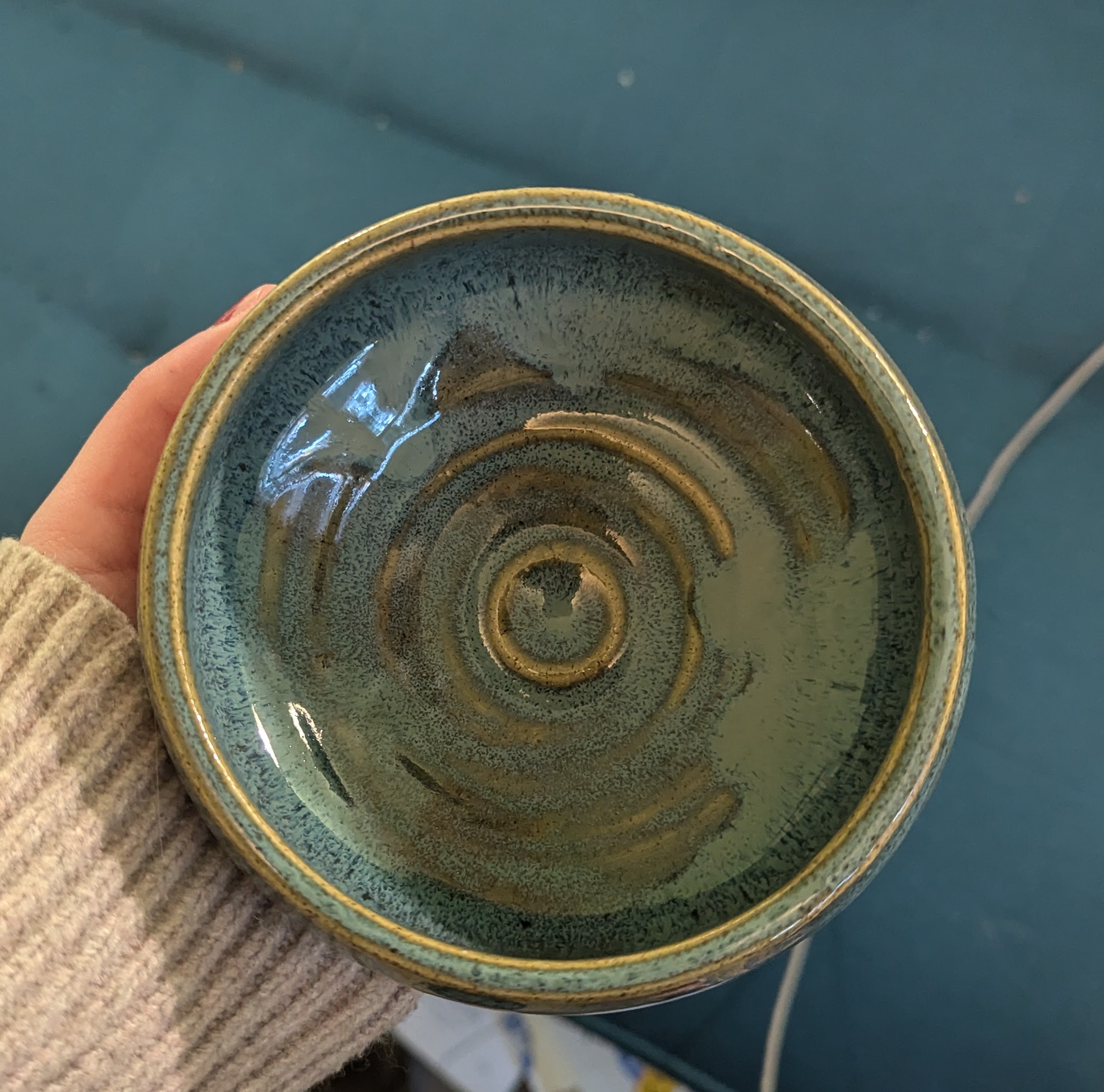
Some recent pieces from my studio:
Published in 2017 Bridgewater International Poetry Festival, 2018
This anthology is the result of the Bridgewater International Poetry Festival. In 2017, the festival occurred in January and was held at Bridgewater College, a small school nestled in the Shenandoah Valley. In this anthology, we have used poems read at this year’s festival to attempt to answer the questions unasked by the title: what, exactly, lies beyond the frame? I hope you find the answer here satisfactory enough to look further beyond your own frame, whether it be the frame of your laptop, your window, or your doorway.
Published in 2018 Bridgewater International Poetry Festival, 2019
This anthology, like the ones before it, is a result of the Bridgewater International Poetry Festival, which is held annually at Bridgewater College in the middle of Virginia’s Shenandoah Valley. The anthology begins with poems that describe who we, the collective whole, are and how we feel. As you read these poems, and indeed, all of the poems collected here, I challenge you to dive deeper than the surface of these poems and to explore the true depth of the lives presented.
Published in Proceedings of the 2025 Conference on Empirical Methods in Natural Language Processing, 2025
Language transfer is an important topic of research in second language acquisition and computational linguistics. The availability of suitable learner corpora is paramount for the study of second language acquisition (SLA) and language transfer. However, curating learner corpora is a challenging endeavor as high quality learner data is rarely publicly available. This results in only a few such corpora available to the community. To address this important gap, in this paper we present LENS, a novel English learner corpus with longitudinal data which enables researchers to investigate language learning over time. LENS contains 687 instances written by speakers of 15 different L1s. We use LENS two perform two important tasks at the intersection of SLA and Computational Linguistics: (1) Native Language Identification (NLI); and (2) an evaluation of large language models as a tool for high-precision, semi-automated annotation of L1 interference features.
Recommended citation: Poorvi Acharya, J. Elizabeth Liebl, Dhiman Goswami, Kai North, Marcos Zampieri, and Antonios Anastasopoulos. 2025. Tracing L1 Interference in English Learner Writing: A Longitudinal Corpus with Error Annotations. In Proceedings of the 2025 Conference on Empirical Methods in Natural Language Processing, pages 15146–15167, Suzhou, China. Association for Computational Linguistics.
Download Paper
Published in Proceedings of the Ninth Workshop on the Use of Computational Methods in the Study of Endangered Languages (ComputEL-9), 2026
We investigate how training languages should be selected for cross-lingual IPA ASR on unseen languages. Using Common Voice audio and Vox Communis phonetic transcripts, we train multilingual IPA-based ASR models for Upper Sorbian, Luganda, and Tatar under three linguistically motivated selection strategies: genealogical relatedness, geographic proximity, and phonological inventory overlap. We compare these strategies to a random baseline and evaluate performance with phone error rate. Linguistically informed selection generally improves transfer, but no single strategy is consistently optimal. Geographic proximity performs best for Luganda, phonological overlap is slightly best for Tatar, and none of the proposed strategies outperform random selection for Upper Sorbian. The results suggest that linguistic similarity aids low-resource ASR transfer, but that the most useful dimension of similarity varies by target language.
Recommended citation: J. Elizabeth Liebl, Summer Chambers, Matthew Kelley, and Géraldine Walther. 2026. Aspects of Selecting the Right ASR Training Languages for Under-Resourced Languages. In Proceedings of the Ninth Workshop on the Use of Computational Methods in the Study of Endangered Languages (ComputEL-9), pages 148–156, San Diego, California, USA. Association for Computational Linguistics.
Download Paper
Published:
Language documentation involving diaspora communities presents a combination of challenges and opportunities for approaches leveraging large data collection and assisted transcription and annotation. Demonstrating our projects on Kichwa and Mapudungun, we present a suite of our computational tools designed to effectively work with diaspora communities for language documentation.
Undergraduate course, University 1, Department, 2014
This is a description of a teaching experience. You can use markdown like any other post.
Workshop, University 1, Department, 2015
This is a description of a teaching experience. You can use markdown like any other post.